Certain challenges are inherent to industrial cooling systems. When these challenges are not addressed your company may experience reduced operational efficiency, increased cost, increased water usage and reduced life on your equipment.
We want to partner and develop a customized solution that fits YOUR SYSTEMS NEEDS.
Assessment
Collaborate
Evaluate
Compliance
Examples of the Types of Systems We Treat
Open Recirculating
Closed Chilled Loops
Cooling Towers
Evaporative Condensers
Why should I treat my water cooling system?
Increase operating efficiency
Reduce maintenance and operational cost
Prevent unplanned system outages
System reliability
Decrease in chemical spend
Reducing water usage
Extend equipment life
Our SolidGuard® Chemistry Program
A More Sustainable Solution for Cooling Towers and Closed Loops.
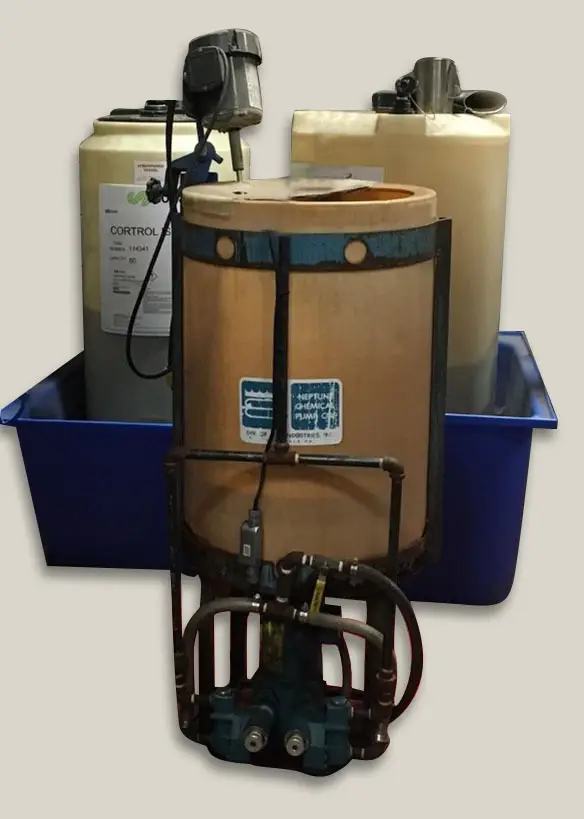
Before
After
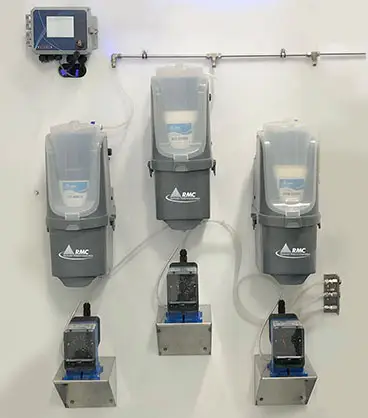
RMC’s SolidGuard® Program is an innovative, effective alternative to traditional liquid water treatment that will help raise your bottom line. These highly concentrated products are packaged in 1 gallon containers and 6″ disc’s with companion dissolve units.
A Safer Alternative to Liquid Chemical that Actually Works for Cooling Tower Efficiency.
We get it, there are a lot of chemical companies that say they are going to save money, time etc. etc. but often they don’t deliver on the promised results.
Our business is to help you decrease water use and chemical use, and minimize energy costs. We pay close attention to the goals you have set (or developed or put into place) for your building and will aim to achieve what matters most to you: keeping your people safe and systems running efficiently.
By Switching to Solid Chemistry you Will:
- Keep Your Team Safe: No more handling 55 gallon drums or splashing and spilling of highly acidic or alkaline chemicals
- Save on Freight Costs: Liquids can cost almost four-times the amount of solids to ship
- LEED Potential: CO2 reduction is a direct result of switching to solid chemistry.
- Less Frequent Delivery/Less Refills Required: Solid Chemistry discs are stacked in the dissolver (up to 4 per dissolver) and allows for complete product use.
First Month Free for New Qualified Customers!* Sign Up Now!
*First month Free for qualified new customers. Some restrictions may apply.
Cooling Water Inhibitor Programs
Our cooling water programs provide clean heat transfer surfaces by providing protection from corrosion, scale and biological fouling. Our treatment options include All Organic, Stabilized Phosphate, Phosphate and Molybdate inhibition programs used in conjunction with a wide selection of biocide programs to ensure efficient cooling system operations.
- Scale and Corrosion Inhibitors
- Biocides — Oxidizing and Non-Oxidizing
- Antifoam
- Feed and Control Systems
- System Cleaners
- Advanced Oxidation System
- Legionella Management and Risk Control
Frequently Asked Questions
Why do we measure water temperature? What is the impact on water treatment?
Water temperature has an effect on all aspects of water treatment including the rate of corrosion, the rate of bacteria growth and the rate of scale formation.
The higher the water temperature, the more corrosive oxygen, and therefore the water becomes. For every 10 degree C increase the temperature, the rate of the corrosion reaction approximately doubles (Arrhenius’s rule).
At higher water temperatures the potential for scale formation also increases. The minerals that most readily form scale, calcium, and alkalinity, are inversely soluble as the water temperature increases. This means that the higher the temperature, the more likely they are to combine, solidify, and deposit as scale. Most other minerals are just the opposite and dissolve more readily as the temperature of water increases. If you add sugar to a cold glass of tea, you can dissolve more sugar into the tea if you heat it up. Calcium and alkalinity are more likely to form scale as the water becomes warmer, so we have to pay attention to the water temperature to understand how readily the water will form scale.
At warmer temperatures, bacteria will also flourish. Ideal temperatures for Legionella growth are between 77F and 113 F. These are also ideal temperatures for other bacteria growth. Increased biocide feed is needed in the spring and summer months as the sun gets stronger and the water temperature gets warmer. Bacteria that forms a film on heat transfer surfaces prevents heat transfer and heat removal from the building because it is so insulating. Bacteria and slime on cooling tower fill attracts dirt, dust, and other debris, including scale and starts to prevent water flow through the tower fill. When water flow is slowed, the rate of cooling of the tower water slows down and prevents the chiller from working efficiently which may impact the ability of the HVAC system to adequately cool the building or manufacturing facility or process.
Since water temperature has such an impact on all aspects of water treatment, we measure the temperature to help ensure that we are not forming scale or getting increased corrosion rates at the water temperatures in the cooling water system.
The same is true for boiler systems, but the concern in a boiler system is not bacteria growth, but oxygen corrosion and scale formation.
At the higher temperatures in a boiler system, oxygen pitting is a concern because oxygen will react at a high rate over a small surface area resulting in a very deep hole which may quickly penetrate the metal surface. Therefore, in a boiler steam system, the oxygen needs to be removed from the water through the process of deaeration and chemical oxygen scavengers to prevent severe corrosion.
Scale formation also increases at a much greater rate as boiler water is evaporated to produce steam. In order to minimize the scale formation between calcium and the alkalinity ions, we remove calcium and magnesium (or hardness ions) with a softener.
The higher the water temperature, the greater the rates of both corrosion and scale formation, so we measure the water temperature because of the impact it has on all three aspects of water treatment, including bacteria growth in cooling water systems.
Why are two different biocides used?
In a typical cooling tower system, it is recommended that two biocides are used to minimize bacteria growth. Either an oxidizer and a non-oxidizer or at the very least an oxidizer and a bio-dispersant with biocidal properties in it.
Oxidizing biocides such as chlorine, bromine, oxidize or “burn” the organism or cell structure, leading to cell death. Oxidizing biocides are effective, act very quickly and cost less than non-oxidizing biocides. They are broad-spectrum biocides, which means that they are capable of killing different organisms including bacteria, algae, and fungi within a matter of minutes. Oxidizing biocides are either fed continuously to maintain a low level of free chlorine or bromine in the system to maintain control of bacteria growth (0.2 – 0.5 ppm) or they are slug fed two or three times a week to higher levels (1 – 3 ppm) and alternated with a non-oxidizing biocide. Oxidizing biocides can be corrosive which is another reason it is recommended that they be alternated with non-oxidizers. In order to kill an organism, the oxidizing biocide must be able to reach it and these compounds are poor at penetrating biofilms and dispersing anaerobic bacteria, so they do not offer extended prevention of bacteria growth. It is for this reason that a bio-dispersant or non-oxidizer needs to be fed in addition to the oxidizing biocide.
A non-oxidizing biocide penetrates and destroys biofilms. Non-oxidizers are more organism specific, may be pH specific, and take longer to affect a “kill.” They also remain in the system longer than oxidizing biocides. They kill bacteria by interfering with their metabolism, stopping respiration, or destroying the cell wall. Non-oxidizers must be fed in the correct amount, and that lethal amount must be maintained in the system for 4 – 24 hours in order to be effective at penetrating and killing bacteria. Non-oxidizers should not be slug fed at the same time as an oxidizer – the oxidizer may de-activate the non-oxidizer. Non-oxidizers are more effective than oxidizing biocides at long-term prevention of bacteria growth. Non-oxidizers include: isothiazoline, glutaraldehyde, DBNPA, quaternary amines and bronopol to name a few.
In order to understand the importance of alternating biocides and/or using a bio-dispersant, we need to discuss how bacteria exists in a cooling water system. The majority of the bacteria in a cooling water system is on the system surfaces (cooling tower, condenser tubes, piping) and is called “sessile” bacteria. This bacteria is very insulating and acts as food for other bacteria in the system. It also makes up 90% of the bacteria in a system. The bacteria that floats around in the water is called “planktonic” bacteria and is much easier to kill with an oxidizing biocide than the organisms on the system surface. Since it is easier to kill the bacteria in the bulk water, it is important to penetrate and remove the bacteria from the surface of the cooling water system with a non-oxidizer or bio-dispersant specifically designed to penetrate and remove the organisms from the surface.
A bio-dispersant would be fed a couple of hours before an oxidizing or non-oxidizing biocide to penetrate and remove the biofilm from the system surface in order for the biocide to easily access the organism to destroy it. Typically, less biocide is needed when a bio-dispersant is used.
An oxidizing biocide with a non-oxidizer and/or a bio-dispersant have proved to be the best way to maintain a clean, efficient cooling water system.
How often should I clean my cooling tower, and do I still have to clean my tower if I feed chemical to it?
A year-round cooling tower should be cleaned and disinfected twice a year. Once at start up or shut down with a full system disinfection and manual tower cleaning from top to bottom and again in the middle of the summer with a full system disinfection and a vacuum of the basin at a minimum. A seasonal cooling tower that runs in the summer only, should be cleaned at least once a year at either the beginning or end of the season with a full system disinfection. Towers need to be physically cleaned even when chemical is fed to the system.
A cooling tower utilizes air flow to evaporate the water that runs over the top of the tower and down to the basin. The process of evaporation via the air flow is what cools the tower water and allows it to remove additional heat from the building. As the air flows through the tower, the material in the air surrounding the tower gets trapped in the cooling tower – dust, leaves, pollen, insects, and other debris. In effect, the cooling tower acts like a large vacuum cleaner, picking up the material in the air surrounding it. Chemical treatment will not completely prevent the number of debris that is pulled into the tower from settling into the tower basin and into low flow areas. As debris is pulled into the cooling tower and settles in the tower basin, it moves with the water and can clog strainers and low flow areas in the piping system. The debris and mud in the bottom of the tower can also attract and function as food for bacteria growth and minimize the contact of the chemical with the tower metal which results in under-deposit corrosion and bacteria fouling. The debris and mud in the tower fill and at the bottom of the tower and in the strainers not only needs to be disinfected to prevent bacteria growth and water borne illnesses, but the material also needs to be physically removed from the tower to maintain efficiency.
What is the difference between salt deposits on the outside of the cooling tower fill and scale deposits in the area where the water flows heavily through the fill or in the condenser tubes?
You now have a thriving chemistry program for your Cooling Tower, but there are an additional steps that will help with life expectancy and may even be regulated in your area. RMC’s Cooling Tower Disinfection services will allow your system to perform more efficiently, increase profitability, and reduce potential liability risk.
You now have a thriving chemistry program for your Cooling Tower, but there are an additional steps that will help with life expectancy and may even be regulated in your area. RMC’s Cooling Tower Disinfection services will allow your system to perform more efficiently, increase profitability, and reduce potential liability risk.