At RMC we are dedicated to making your business and the world a safer place. We collaborate with your team to develop customized solutions to manage the risks associated with Legionella. Our team has in-depth knowledge of all regulations related to HVAC and domestic water systems, ensuring that we stay up to date with federal, state, and local guidelines.
We are well-versed in key regulations and standards, including:
- JCAHO EC 1.7 Compliance (The Joint Commission)
- ASHRAE 188-2018
- Local Law 76
- Local Law 77
- CMS Memorandum 17-30
- Chapter 8 Title 24 of New York City
- NYS Title 10 Part 4
- New Jersey Senate Bill 2188
- Decree 454-2014 from the Government of Quebec
- Bill 91, titled An Act to Amend An Act to Incorporate The New Brunswick Registered Barbers’ Association
Additionally, beginning May 7, 2026, New York City Local Law 159 requires facilities to integrate monthly microbiological testing into routine operations as part of a comprehensive compliance framework.
Rest assured, RMC is here to guide you in meeting these standards and keeping your operations safe and compliant.
Brief History
Legionnaires’ disease was first identified during the summer of 1976, at the Bellevue-Stratford Hotel in Philadelphia, Pennsylvania. Where 200 individuals fell ill and 34 tragically lost their lives. This event marked the first global discovery of Legionella pneumophila.
Are you familiar with the bacterium Legionella pneumophila?
Legionella pneumophila can lead to Legionnaires’ disease or Pontiac fever. While most individuals who come into contact with the bacterium do not become ill, certain groups are more susceptible. These include, but are not limited to, smokers, individuals over the age of 50, and those with lung or autoimmune diseases. The disease is typically contracted when contaminated water droplets are inhaled or aspirated into the lungs.
Legionella pneumophila can thrive in environments such as cooling towers and evaporative condensers—both of which are wet-type heat rejection devices capable of producing large volumes of mist.
What environments does the bacterium thrive in?
Legionella pneumophila can thrive in environments such as cooling towers and evaporative condensers—both of which are wet-type heat rejection devices capable of producing large volumes of mist.
What is Biofilm?
A biofilm is a collection of surface-associated microbial cells encased in polymeric substances, forming an extracellular matrix.
Biofilm is the place where bacteria grows and colonizes in the system.
How are Biofilms formed?
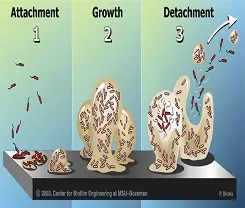
Biofilm forms when certain microorganisms adhere to a surface in a moist environment and begin to reproduce. These microorganisms attach to the surface by secreting a slimy, glue-like substance. Biofilm can develop on a variety of surfaces, including but not limited to evaporative cooling tower fill material, heat exchangers, cooling water systems and pipelines.
There are two types of bacteria in a plumbing system: planktonic and sessile. The planktonic population includes all the bacteria that are not attached or inside the biofilm and that flow within the water stream. The sessile bacteria are the ones that exist in the biofilm itself and are attached to a surface.
In several countries, there has been significant concern over the health and legal implications of Legionnaires’ disease. This has led to the implementation of government regulations, including mandatory disinfection protocols.
A cooling tower utilizes air flow to evaporate the water that runs over the top of the tower and down to the basin. The process of evaporation via the air flow is what cools the tower water and allows it to remove additional heat from the building. As the air flows through the tower, the material in the air surrounding the tower gets trapped in the cooling tower – dust, leaves, pollen, insects, and other debris. In effect, the cooling tower acts like a large vacuum cleaner, picking up the material in the air surrounding it. Chemical treatment will not completely prevent the number of debris that is pulled into the tower from settling into the tower basin and into low flow areas. As debris is pulled into the cooling tower and settles in the tower basin, it moves with the water and can clog strainers and low flow areas in the piping system. The debris and mud in the bottom of the tower can also attract and function as food for bacteria growth and minimize the contact of the chemical with the tower metal which results in under-deposit corrosion and bacteria fouling. The debris and mud in the tower fill and at the bottom of the tower and in the strainers not only needs to be disinfected to prevent bacteria growth and water borne illnesses, but the material also needs to be physically removed from the tower to maintain efficiency.
Understanding ASHRAE 188-2018
The ASHRAE 188-2018 standard sets minimum requirements for both potable and non-potable water systems that may be susceptible to Legionellosis. For detailed information, please visit the ASHRAE website to obtain a copy of the standard.
The RMC Water Safety Team is highly knowledgeable in the ASHRAE 188-2018 standard and will collaborate with your company to ensure full compliance with all required components.
- Survey Completion
- Control Locations
- System Maintenance
- Monitoring
- Startup & Shutdown
- Control Measures
- Testing
- Disinfection
- Corrective Actions
- Water Management Plan
- Team establishment which includes educational opportunities
- Adherence to national, regional and local regulations

Legionella's Impact on your Business
Legionella in your water system can directly affect your business via your equipment, people, and your bottom line.
Here are some of the scenario’s you could face:
Biofilm has built up in your cooling system increasing operating costs, reducing heat transfer and potentially harboring deadly bacteria. It may now be necessary to pay for costly repairs with the hope that the system does not need to be fully replaced.
Iron deposits are building up in your domestic water system and is interfering with sensitive equipment for your Healthcare facility. The domestic water plumbing is old, but could have potentially been left in place for another six years. It now appears that it will need to be replaced within three years due to neglect and lack of flow.
The nursing home you manage is currently experiencing an outbreak of Legionnaires’ disease—a serious waterborne illness that may have been preventable. The local health department has launched an investigation, which could result in tens of thousands of dollars in testing costs and regulatory fees. In addition, media coverage of the outbreak has created a public relations challenge for the facility.
Legionella Risk Management Program
RMC’s Risk Management Program offers customized ways to provide contingency management against potential litigation and associated health risks. The plan is provided for the management of pathogenic biological agents.
The Programs have five major components:
- Defined by all relevant federal, state, and local laws
- The use of certified independent labs
- Short & Long Term customized strategies
- System Risk Assessments
- Intensive Treatment Programs
For a more in depth look at our program options; check out our Legionella Best Practices.